
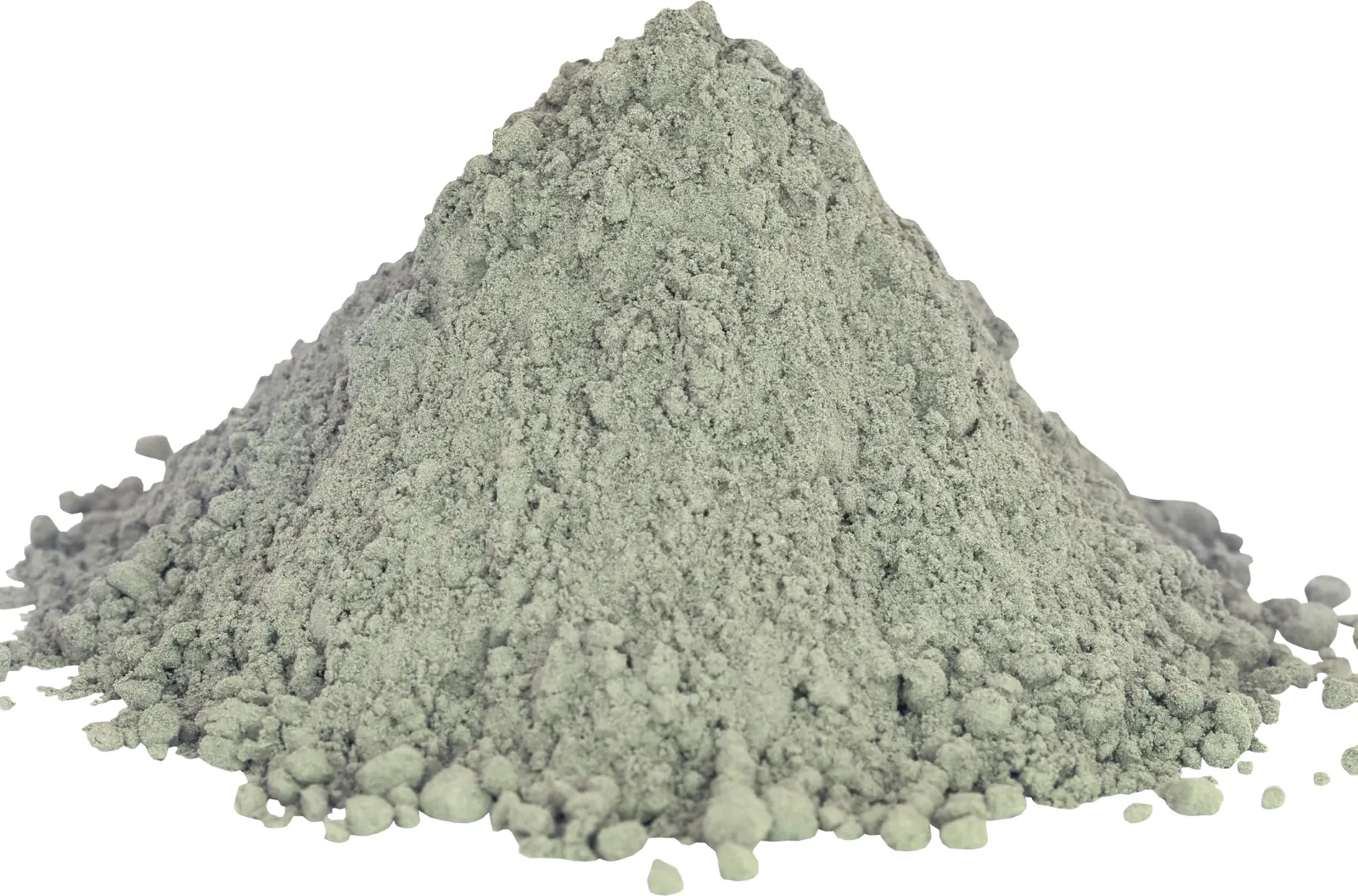
Silica fume (microsilica) is an ultrafine, amorphous silicon dioxide (SiO2) byproduct of silicon and ferrosilicon production, used as a high-performance pozzolanic admixture in concrete to dramatically increase compressive strength, reduce permeability, and improve chemical and abrasion resistance. Conforming to ASTM C1240, it typically contains 85–98% amorphous SiO2 with spherical particles roughly 0.1–0.3 microns in diameter — about 100 times finer than portland cement. This page explains what silica fume is, how it works in concrete, the available grades, dosage guidance, and how concrete producers and admixture formulators can source it in bulk from RawSource.
Reviewed and updated July 2026 by the RawSource technical team.
What Is Silica Fume?
Silica fume, also called microsilica or condensed silica fume, is a byproduct of producing silicon metal and ferrosilicon alloys in electric arc furnaces. As the furnace reduces high-purity quartz, SiO vapor escapes, oxidizes, and condenses into extremely fine, glassy (non-crystalline) spheres of silicon dioxide. This material is captured in baghouse filters and refined into a supplementary cementitious material (SCM).
Note: silica fume is not the same as fumed silica or colloidal silica. Those are manufactured high-purity silicas used as thickeners, anti-settling agents, and polishing abrasives, whereas silica fume is a recovered pozzolan added to concrete. See our comparison of fumed silica, colloidal silica, and silica fume for the full distinction.
Because the silica is amorphous rather than crystalline like quartz, it is highly reactive in concrete. Combined with its enormous surface area, this makes silica fume one of the most effective pozzolans used in high-performance concrete. It is a recovered industrial byproduct — a recycled material by origin — rather than a primary-mined additive. (This describes where the material comes from; it is a factual statement about origin, not a sustainability or environmental claim.)
In specification terms, silica fume is governed primarily by ASTM C1240 in North America and EN 13263 in Europe. These standards set minimum amorphous SiO2 content, maximum loss on ignition and moisture, a minimum specific surface area, and a pozzolanic activity (accelerated) index. Material that conforms to these standards is what concrete producers and admixture formulators qualify into structural mix designs.
Key Properties of Silica Fume
| Property | Typical Value / Range | Why It Matters in Concrete |
|---|---|---|
| SiO2 content | 85–98% (amorphous) | Drives pozzolanic reactivity; ASTM C1240 requires ≥85% |
| Average particle size | ~0.1–0.3 µm | ≈100× finer than cement; fills microscopic voids |
| Specific surface area | ~15–30 m²/g (BET) | High surface area accelerates reaction |
| Bulk density (undensified) | ~130–430 kg/m³ | Very light, dusty; harder to handle |
| Bulk density (densified) | ~480–720 kg/m³ | Easier transport, storage, and batching |
| Form | Amorphous (non-crystalline) | More reactive than crystalline silica |
| Color | Light to dark gray (white grades available) | White grades suit architectural concrete |
| Reference standard | ASTM C1240 / EN 13263 | Specifies SiO2, LOI, surface area, reactivity |
Because of its high surface area, silica fume increases the water demand of a mix, so it is almost always paired with a high-range water reducer (superplasticizer) to maintain workability at a low water-to-cementitious ratio.
How Silica Fume Works in Concrete
Silica fume improves concrete through two complementary mechanisms:
- Pozzolanic reaction: As portland cement hydrates, it releases calcium hydroxide (Ca(OH)2, also called portlandite) — a relatively weak, soluble byproduct. The amorphous SiO2 in silica fume reacts with this calcium hydroxide to form additional calcium silicate hydrate (C-S-H), the primary binder that gives concrete its strength.
- Physical pore refinement (filler effect): Silica fume particles are roughly 100 times smaller than cement grains, so they pack into the spaces between cement particles and at the paste-aggregate interface. This densifies the microstructure, refines the pore network, and sharply reduces permeability.
Together, converting weak portlandite into strong C-S-H while physically tightening the pore structure is why silica fume delivers both higher strength and dramatically lower permeability than plain portland cement concrete. A large part of the benefit occurs at the interfacial transition zone — the weak, porous band of paste immediately surrounding each aggregate particle. Silica fume densifies this zone, which is normally the weakest link in concrete, improving the bond between paste and aggregate and raising overall strength.
One practical consequence is that silica fume concrete continues to gain a meaningful share of its strength early, unlike fly ash, which develops strength slowly over weeks. This makes silica fume well suited to projects that need high early strength as well as long-term durability — though proper dispersion during mixing is essential, since poorly dispersed silica fume agglomerates do not contribute fully to the reaction.
Benefits of Silica Fume in Concrete
| Benefit | Mechanism | Where It Matters |
|---|---|---|
| Higher compressive & flexural strength | Additional C-S-H + denser matrix | High-strength / high-performance concrete (HPC) |
| Very low permeability | Refined pore structure | Marine, water-retaining, and parking structures |
| Chloride & corrosion resistance | Blocks chloride ingress to rebar | Bridge decks, marine, deicing-salt exposure |
| Sulfate & acid resistance | Lower permeability + reduced free lime | Wastewater, industrial, chemical exposure |
| ASR mitigation | Consumes alkalis via pozzolanic reaction | Reactive-aggregate regions |
| Abrasion & erosion resistance | Harder, denser surface | Spillways, industrial floors, hydraulic works |
| Improved shotcrete performance | Better cohesion, less rebound | Tunneling, slope stabilization, repair |
Silica Fume vs. Other Supplementary Cementitious Materials
Silica fume is often compared with fly ash and ground granulated blast-furnace slag (GGBFS). All three are SCMs and industrial byproducts, but they differ sharply in fineness, reactivity, and typical dosage. Many high-performance mixes use silica fume together with fly ash or slag to balance strength, durability, and cost.
| Silica Fume | Fly Ash (Class F) | Slag (GGBFS) | |
|---|---|---|---|
| Source | Silicon / ferrosilicon production | Coal combustion | Iron / steel blast furnaces |
| Particle size | ~0.1–0.3 µm | ~10–100 µm | ~10–30 µm |
| Reactivity | Very high | Low–moderate (slow) | Moderate |
| Typical replacement | ~5–12% | ~15–30% | ~25–50% |
| Strength effect | Large early & ultimate gain | Slow, long-term gain | Long-term gain |
| Permeability reduction | Greatest | Good | Good |
| Primary use | HPC, durability, ASR control | Workability, heat reduction, ASR | Durability, mass concrete |
Silica Fume Dosage and Addition Rates
Silica fume is typically used to replace or supplement 5–12% of the cementitious material by mass, with most structural high-performance mixes landing in the 7–10% range. Lower dosages emphasize workability and modest strength gains; higher dosages target maximum strength and durability but increase water demand and make the mix stickier, so a superplasticizer becomes essential.
Above roughly 12–15%, returns diminish and water demand rises sharply. Exact dosage should always be confirmed by trial batches against project specifications and the mix design — these are general industry ranges, not a substitute for mix qualification.
Forms of Silica Fume: Densified, Undensified, and Slurry
- Undensified silica fume — the raw as-collected powder (bulk density ~130–430 kg/m³). Most reactive form, but dusty and difficult to handle and transport. Used where maximum pozzolanic activity is needed.
- Densified silica fume — particles agglomerated into larger clusters (bulk density ~480–720 kg/m³). The most common commercial form: easier to store, transport, and batch with far less dust. Standard choice for ready-mix and precast plants.
- Silica fume slurry — undensified silica fume suspended in water (often ~50/50 by weight). Eliminates dust and supports precise, uniform dosing in automated batching for large projects such as dams and tunnels.
- White silica fume — a low-iron grade for architectural and decorative concrete where appearance matters, delivering the same performance benefits.
Applications of Silica Fume
- High-strength / high-performance concrete (HPC): high-rise columns, long-span structures, and precast elements requiring superior load capacity.
- Bridges, parking decks, and marine structures: resisting chloride ingress, deicing salts, and seawater to protect embedded reinforcement.
- Shotcrete: tunneling, mining, and slope stabilization, where it improves cohesion and reduces rebound.
- Oil-well cement: high-temperature, aggressive downhole environments.
- Repair and overlay mortars: bonded overlays and structural repairs needing durability and low permeability.
- Industrial floors, spillways, and hydraulic works: abrasion- and erosion-resistant surfaces under heavy load.
Silica Fume Supplier — Bulk Supply from RawSource
- Grades: standard gray densified and undensified silica fume, slurry, and white (low-iron) architectural grades.
- Packaging: bags, super-sacks (bulk bags), and bulk/container loads to match your batching and logistics.
- Documentation: Certificate of Analysis (CoA) and specification data provided with shipments for QA/QC and mix qualification.
- Bulk RFQ model: send your grade, SiO2 spec, form, volume, and delivery location and we return pricing and lead time.
Frequently Asked Questions About Silica Fume
How to use silica fume in concrete?
Batch silica fume as a cementitious material at the plant. Densified powder is the standard commercial form and handles like cement in silos, super-sacks, or bags. Weigh it accurately, pair it with a high-range water reducer to hold a low water-to-cementitious ratio, and extend mixing long enough to break up the densified agglomerates: the Silica Fume Association cautions that mixing must be adequate to disperse them, and suggests undensified silica fume where a mixer cannot manage it.
Why is silica used in concrete?
Silica is used in concrete as silica fume because it improves the material in two ways at once. Chemically, its amorphous SiO2 reacts with the calcium hydroxide released during cement hydration to form additional calcium silicate hydrate, the binder that carries strength. Physically, its sub-micron particles pack the voids between cement grains. The combined effect is higher compressive strength, lower permeability, and better resistance to chlorides, sulfates, and abrasion, which is why specifiers call for it on bridge decks, marine structures, and high-performance mixes.
Is silica fume a pozzolan?
Yes. Silica fume is classified as a pozzolanic supplementary cementitious material: it gains strength by reacting with the calcium hydroxide that hydrating portland cement releases rather than by hydrating on its own. ASTM C1240 tests this reactivity directly and requires an accelerated pozzolanic activity index of at least 105 percent of the control mix at seven days. High amorphous SiO2 content and extreme fineness make it one of the most reactive pozzolans qualified into concrete.
What is silica fume?
Silica fume is an ultrafine, amorphous silicon dioxide (SiO2) byproduct of silicon and ferrosilicon production, used as a high-performance pozzolanic admixture in concrete to increase strength and durability and reduce permeability.
What is silica fume used for?
Silica fume is used to make high-performance and high-strength concrete for bridges, marine and parking structures, shotcrete, oil-well cement, industrial floors, and repair work, where high strength, low permeability, and chemical resistance are required.
How much silica fume do you add to concrete?
Silica fume is typically dosed at about 5–12% of the cementitious material by mass, with most structural mixes using 7–10%. A superplasticizer is normally required, and the final dosage should be confirmed by trial batches against the project mix design.
Is silica fume the same as microsilica?
Yes. Silica fume, microsilica, and condensed silica fume are different names for the same material — the ultrafine amorphous SiO2 byproduct of silicon and ferrosilicon production used in concrete.
Where can I buy silica fume in bulk?
Submit a bulk RFQ with your grade, specification, and volume to receive pricing and lead time.
Conclusion
Silica fume is one of the most effective supplementary cementitious materials available for concrete. By converting weak calcium hydroxide into strong C-S-H and physically refining the pore structure, it delivers higher strength, far lower permeability, and superior resistance to chlorides, sulfates, abrasion, and alkali-silica reaction. Whether you are formulating high-performance concrete or sourcing material for a ready-mix or precast operation, RawSource can supply silica fume in the grade, form, and packaging your project requires.
Search 1,300+ industrial chemicals by name or CAS, or send us your spec — we quote by the drum, tote, or container.
Browse the Chemical Index → Request a Quote